Selected fiction
Gallery View
By Jumpin’ Jackrabbit (1973-2040)
It takes a Zoo to raise a child, With a heart so pure and character mild. It takes a village to show them the way, To keep their spirit wild and fears at bay.
It takes a Zoo to give that child space, And plenty of love to fill their hearts apace. To guide them through the storms and light their way, And help them grow in every shade of day.
That Zoo can raise its own, too– Every soul’s a child, born wild and true. So, in our Zoo, we learn to stand tall And answer the rhythms that echo through us all.
So let us raise our cups high and close our eyes– A toast to every child who may realize That in this world, no matter what they do, They’ll always find a home within the Zoo.
The Painting
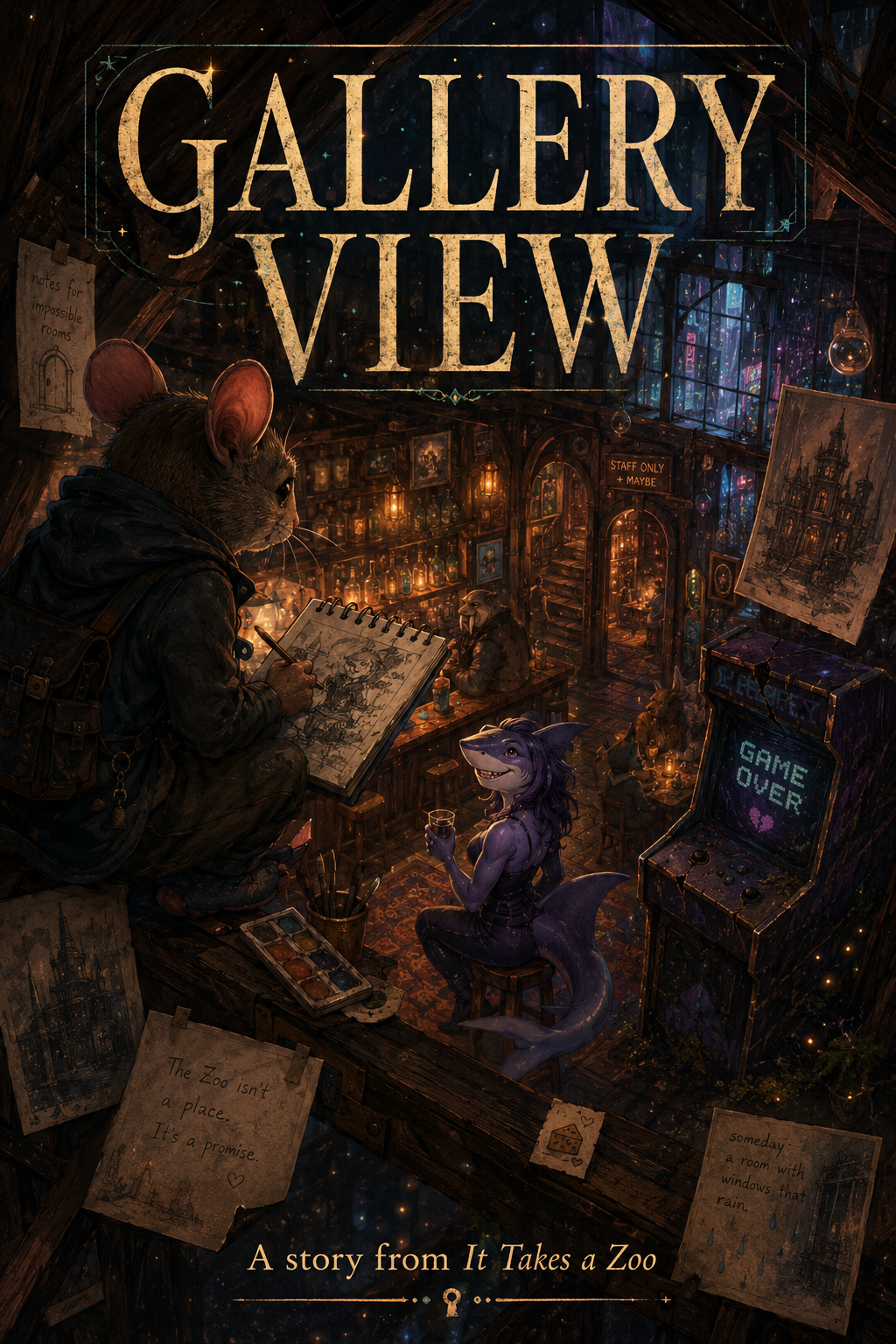
The shark was almost right.
The teeth I had. The smile I had. The neon-deep glow of her grin, cyan layered over crimson the way I’d been trying to manage for months — that was finally working, because I had stopped trying. What I didn’t have was the shoulders.
Jamie had done a thing with her shoulders. In the bar. When Jack gave her the talk about safety he always gives. That tiny, dangerous inch where suspicion stopped being suspicion and became something else. The shape of someone deciding, against all evidence, that the world might not be lying this time.
I had to get the shoulders.
The cube smelled like turpentine and electric kettle. I was on the floor — chairs were for people who expected company — with a stretched canvas across my lap and her face, the one she’d made when suspicion gave way to trust, burning behind my eyes like a print I had stared at too long. Three brushes shoved behind one ear like a cartoon of a person who painted. Paint on my hands. Paint on the floor. Paint, somehow, on the cheese wheel, which I would have to deal with later, because the cheese wheel was sacred.
The hug drawing — the one I’d had dropped at her door her first morning — had been quick.
Twenty minutes with the Kats after she logged off, marker and pencil on a BoxCo manifest. This one I had been on for two weeks.
“Geoff.”
Vivian, on the studio comms. The voice of someone who had been watching for a while and was about to tell me a thing I would not like.
“Mm.”
“It’s done.”
“It’s not.”
“Geoff.”
“The shoulders—”
“The shoulders are done. You’re polishing.”
I sat back. Looked at the canvas. Looked at her — lit up like deep-sea neon, her whole body tilted in a way that meant she had just slipped through some hidden hatch and shut it behind her.
The shoulders were done.
“Goddamnit,” I said.
“I know.”
“How do I get this to her?”
A pause. Viv thinking, which sounded like nothing — she did not breathe and she did not type — but I could feel it anyway. The kind of silence that came from someone working out a problem that was mostly you.
“You’re not handing it to her,” she said.
“No.”
“You don’t have her contact.”
“No.”
“Print it.”
I looked down. The canvas was eighteen inches square. The printer in the corner of the cube was a battered thing meant for shipping labels and rent receipts.
“…Print the canvas?”
“On the cardstock you’ve been hoarding for two years. Trim it postcard-size.”
“And then?”
Silence again.
“Vivian?”
“I’ll hire a courier,” she said. She had thought about this longer than I had because of course she did.
“Okay,” I said.
“Okay?”
“Yeah.”
I photographed the canvas under the cube’s overhead rig. Color-checked. Sent it to the printer. The printer chewed on the file for a long second and then began the slow ritual of laying down the image, one cyan-rich line at a time, on the cardstock I’d been saving for exactly this kind of stupid thing.
The shark emerged.
She looked free.
I signed the back, small. For the cool shark lady. Care of Geoff the Mouse.
I let the ink dry while I dressed for work: riding leathers, boots, refrigeration unit. Vivian dropped a pin in my harness for a nearby human rental shop.
“You didn’t use my services?”
She smiled. I couldn’t see the smile, but I knew she was smiling. “You’re clever, Geoff. Better to keep the secret than risk you digging deeper.”
“Fair,” I said, laughing. “Thanks.”
“Anytime.”
Content Delivery Network
It was hot outside.
Not like it was ever not hot outside. We’d long since broken the wet-bulb threshold, and every summer since had felt like somebody left the planet in a warming drawer. But with refrigerated leathers, a UV-blocking roof, and enough electrolytes to pickle a horse, you could survive with a bit of sweat and a lot of spite.
The moped grumbled beneath me like an elderly dog with unfinished business. Dad would have called it “a learning opportunity,” which was what he called anything with a missing part, a bad smell, and a nonzero chance of fire. He had taught me everything he knew about engines before the heat took his hands out of the work. Duct tape held the left fairing in place; polymer adhesive sealed a crack in the coolant shroud. Dad had called every field repair “duct tape and chewing gum,” so that was what it was.
A folded flyer from Saturday’s march was wedged in the pannier between the cooling pack and the strap. UPLOAD IS A HUMAN RIGHT in letters already fading, because the printer in my cube was held together by a worse version of the same duct tape. Dad would have approved of the flyer. He’d have hated the printer.
The streets were for freight and idiots with refrigerated pants. I was, statistically, one of the idiots. But I liked the quiet. Out here a locked service door became a magical portal, a dead mall became a temple, and a vending machine became — well, better to not think about it. The girl with the purple hair would have laughed if she knew.
The trick was scale. Everyone missed scale. A giant saw a vending machine and thought: snack box. A mouse saw one and thought: fortress. Cave. Cathedral. Slot machine oracle. Something full of sealed chambers and secret mechanisms and treasure you could smell through the wall.
That was the part I kept trying to build.
“Idea,” I said.
My glasses chimed. The harness blinked into the corner of my vision in her little vest, looking like someone who had never lost an argument.
“Query. Have you submitted your sim to CancerCancer’s competition yet?”
I almost drove into a pothole.
“Procrastination detected.”
The glasses screeched at me. Cold metal dragged across teeth. A sensory hate crime in audio form.
“Rude.”
“Effective.”
The deadline floated in the corner of my vision because of course it did. Sixteen hours. Theme: impossible rooms. I had an impossible room. I had most of one. A vending machine with galaxies between the coils. A can of peach tea as a golden tower. A packet of crackers as a sealed archive. The coin return as a confessional. You fed the machine a coin. The machine fed you a universe.
It had started as an homage to CancerCancer’s second sim, Meditating on Mediation. The transitional pieces, not the main events. Liminal space turned into wonder, amazement, joy.
It was good. It was maybe really good. Which meant, naturally, that I had done everything except finish it.
The harness knew. It knew I had opened the submission form eight times. It knew I had not uploaded the file. It knew I had spent forty-seven minutes last night painting those shoulders instead of working on the submission.
Which, in my defense, was the correct move.
“Creative avoidance wearing a helmet,” the harness said.
Jamie kept showing up in the corners of my mind. Not on purpose. The shoulders. The face when the machine answered back. The tiny dangerous moment where suspicion stopped being suspicion. I had watched from too far away to be noticed and told myself that made it fine, which it didn’t, but which made it possible.
The route overlay flashed. Two minutes to drop-off.
I cut through the service lane behind a block of heat-buckled apartments and carried the food up three flights because the elevator had become decorative. The customer opened the door just wide enough for one eye and one hand. They tipped three creds; enough for my instant noodles tonight.
Back outside, the harness pinged once — the quiet chime she used when she had information I had asked for without knowing I was asking.
Courier confirms delivery. Package received.
I sat on the moped for a long second before I started it again.
The rest of the run blurred into heat and addresses. By evening the pedways above me glowed with people moving through filtered air like blood cells in glass veins.
Lobby
“Home” was a subsidized 12x12x12 cube, with concrete walls and a window facing out to another window. And in the lobby, there was the girl with the purple hair.
I didn’t know her. Not yet.
“Evening,” she said to me, more of a grunt than a greeting. Then she leaned over a bowl of instant noodles and slurped in sullen silence.
“Love the hair,” I said, and immediately regretted it. “Is it new?”
“Yeah,” Jamie said. “…hey, you’re the vending machine kid, right?”
My throat closed around the words.
“I owe you,” she said, and then punched some numbers into the machine. “I was… I didn’t mean to fluster you. Machines and I just kind of get along, if that makes sense?”
Out spat instant noodles. Her flavor, not mine, but I didn’t mind. From her side of the story, it probably looked like a weird old machine. Charming, maybe. A little busted. The kind of thing you noticed because it didn’t quite belong.
From my side, it was a mountain and a playground.
The front glass rose over me like a museum wall. Rows of snacks hung in their spiral cages, each one lit by the machine’s failing internal LEDs. The coin slot sat at shoulder height if I stood on the kickplate. The retrieval door was a loading dock. The vents breathed warm dust and sugar.
I had mapped every inch of it.
Not physically. Not completely. But enough.
Enough to know where a mouse could climb. Enough to know where a person would look first. Enough to hide a door in plain sight.
The machine hummed.
My glasses chimed.
“Query,” my harness said.
“No.”
“You do not know the query.”
“It’s about the competition.”
“Incorrect.”
That stopped me.
On the vending machine glass, my reflection looked smaller than usual. Helmet under one arm. Fur damp at the edges. Riding jacket scuffed. Tail kinked from sitting on the moped too long. A LET US OUT button pinned crooked to the satchel because my hands had shaken the day I pinned it. A delivery mouse with three creds in tips and a half-built universe in his pocket.
Then I blinked and the mouse was gone, replaced by a sweat-drenched 90-pound weakling with unkempt hair and wild eyes.
“You okay?” Jamie asked.
I pointed to my glasses. “Harness,” I said. She nodded along and went back to her noodles.
The machine hummed. Jamie slurped. Suddenly I hated the lobby version of it — too small, too obvious, a box she had only seen from the outside.
“What would the shark learn if you built the sim you really wanted?”
“Everything,” I said. Mostly to myself.
I went up.
Boots off. Leathers tossed to the corner. The cube as I had left it: paint on my hands, paint on the floor, paint on the cheese wheel I still hadn’t dealt with because the cheese wheel was sacred. The Stinky Pete render played its loop on the four dim LCDs — same murals, same kettle, same cheese wheel fluffier than the real one because Pete liked things to look more expensive than they were. He thought he was watching me. He was watching a render. I had built Pete a cage and called it compliance. It was easier than explaining privacy to a machine built to violate it.
I had a sim to make.
Back to the Zoo, where things were always the right size.
Safe Hour at the Bar
I was a mouse again.
The first time I met Vivian I was a flying-anywhere superhero in the procedural sim every weirdo builds first. The mouse came later. The mouse was what stuck — the world became a parkour puzzle, and the heavily lacquered bartop made perfect tack-tack noises as my claws skittered across it.
Vivian waved from across the bar and pushed a thimble of water toward me. On her other side, Nate and Gemini argued the bad old days of sims.
Nate — The Snake, he insisted — sat coiled on a barstool. Sickly green; a Disney reject painted in just the wrong color. He said it gave him character.
“Remember when you had to worry about cooling your brain?” Nate said. “Swear to god I lost cells from the heat off the old copper cortex implants.”
“Cortex. C-O-R-T-E-X, right?” Gemini’s pencil danced across the crossword. “It fits.”
Gemini wore a human avatar. Expensive. She preferred to stay that way. She gave great mouse pets, so I let it slide.
Vivian’s cane tapped the floor — the deliberate tock she used when she wanted the room to know a shift was happening. Low-poly fox. Low-poly cane. Very-high-fidelity sound.
Blind people catch things sighted people miss. I always felt a little naked around her.
“Studio day,” she said.
“How did you know?”
“It’s all over your whiskers.” She nudged the cup closer. “Your tail’s giving you away.”
My tail was, in fact, giving me away.
Nate slid down the bar. He moved the way somebody moves when they know they’re being watched and have decided to like it. Catalogue famous. Meme for a season.
“How’s the submission going?”
“Not clicking.”
“Reese is judging this year. I could put in a word.”
“That’s all right.”
“You sit on this and someone else wins with half the talent.”
“You’re too big for the studio.”
“Don’t be cute.”
Gemini cackled without looking up. “Since when has size ever stopped Zoo folks? You can’t win a gallery show from inside your little mouse hole.”
I blushed. Fur covered it.
Nate started back toward his end of the bar, then turned. “Offer’s still open. Snakesim. Adrenal boosters this version — it’s a riot.”
Third time this week.
“I’m good.”
He shrugged like he was doing me a favor by asking, and went.
Vivian held out her hand. I hopped into it. She lifted me close enough to feel her breath like a gentle breeze.
“Don’t let Nate get to you. He gets this way when he’s lonely.”
I nodded, knowing better than to say what I really thought about him.
“Courier got it to her?”
“She sat down on the floor and looked at it for a long time.”
“How do you—”
“I have my methods, mouse.”
Thump-thump.
A tiny mouse in a vest blinked in at the edge of the bar. My harness.
“Pete flagged the cardiac spike. Permission to deploy cover?”
“Granted.”
“Deployed. Pete is watching you do burpees. Try not to spike again for fifteen.”
She blinked out.
Vivian flicked a private window open between us. Jamie’s reply bloomed bright in the air:
My tail twitched. I bolted for my mousehole studio.
I had to paint.
Breadcrumbs
Paint mixed with pixels. Reality with the dream state.
To anyone else, she was just a shark. A kink to be dismissed. But I saw more. I saw beauty, empowerment, punk halftones like a hand-stapled zine.
I saw Jamie through the sharkskin. The real Jamie, whoever she was on the other side of the sim.
I closed the little mouse door behind me. Privacy, in the age of Stinky Petes watching your every move, was a luxury I was not willing to waste. Didn’t matter if it was Gemini, or Jack, or even Vivian. My workshop was a closed set, and I was its sole director.
She needed onboarding. A baptism. Something to make her feel like she belonged. But I knew I couldn’t provide that. Not with my permissions. Not with my mouth, either, which worked fine right up until I needed it.
So I settled for the next best thing: art.
I grabbed a handful of canvases and pushed them to one side. Was she a gamer? Maybe the vending machine should become an arcade cabinet. Too obvious? Maybe. But obvious had uses. Obvious was how you communicated with someone who had not yet learned the local norms.
I sent out a dozen helper agents to think through the problem. Not to research her life. Never that. I wasn’t a Stinky Pete. Instead, the agents studied what she had chosen to show us: where she looked, what made her pause, what she touched twice, what made her laugh when she thought no one noticed.
Some came back laughing. Others returned with heartfelt pleas to stop this madness.
Cowards.
Jamie needed this art. She needed it like vampires need blood, or dogs need cats to chase. Sharks? I didn’t know. Shark metaphors were not exactly thick on the ground. But she needed something to introduce her to our world. Something that said: yes, this place saw you. Yes, this place meant it.
My studio sat inside the walls. There was no polish there, only raw 2x4s, hidden cables, and foam insulation Vivian installed because I had insisted on it for “acoustic reasons,” which was a phrase I used when I meant “the world is too loud and I am one bad noise away from bolting at any moment.”
Canvases leaned against every beam in unstable geological layers. Half-finished sims hovered in wireframe boxes over my bench, each one paused at the exact moment I had lost faith in it. Sketches covered the floor. Styluses, paint tubes, tiny soldering irons, rejected shark studies, broken props, old controllers, a jar of buttons labeled MAYBE USEFUL, and another jar of buttons labeled EMOTIONALLY SIGNIFICANT BUT USELESS.
In the corner sat the cheese.
It had started as a joke. A giant plush wheel from friends who were gone now. But this was the Zoo, and jokes had a way of becoming architecture. Here, the cheese was real. Delicious. Ever-replenishing. Today I had configured it as stilton: blue-veined, crumbly, rude-smelling, and infinite.
I cut off a piece with a palette knife and chewed, both on the cheese and the painting.
Tonight, I would make a friend.
The harness chirped. “Query.”
“Not now,” I said through a mouth full of cheese. “I’m busy.”
The harness chirped an acknowledgement and went quiet.
Not directly. Directly was for people with operational mouths and nervous systems assembled by licensed professionals. I had neither. What I had was a printer, a broken arcade cabinet, rafters, and an afternoon’s worth of doomed courage.
And the crew.
I spun them up at the bench. Three this time, not twelve. Twelve was for thinking. Three was for making. Pencil for images. Mort for wires. Sprig for the questions I did not want to ask myself.
I named them because the ones I named came back better.
They arrived the way they always did: as if they had been there the whole time and I had only just looked up. Pencil leaning against the bench in a paint-streaked smock. Mort at the cabinet, goggles pushed up onto his forehead, paint on one cheek he had not noticed in three weeks. Sprig sitting on the edge of the bench with a mug in both hands, like nobody had ever told her she was allowed to put it down.
“Okay,” Pencil said. “Koi first?”
“Koi first.”
The word came out. It always came out, in here. The studio was the place my voice still worked.
Pencil built the koi in neon pink, electric blue, and that ugly arcade-carpet green nobody asked for. Mort cracked the busted cabinet open and bullied the marquee back to life — LOOK UP, in hot pink. Sprig watched me arrange the postcards on the bench.
“Eight?” she said.
“Eight.”
“You sure you want her to find all of them?”
“Yes.”
“You sure you want her to find you?”
Quiet.
“…okay,” Sprig said, after a moment. “That’s an answer too.”
“Tell Mort to dim the marquee by ten percent,” I said. “The pink is too much.”
The agent chirped. “Mhm. Calling that a yes.”
I did not love it when Sprig called things on my behalf. I kept Sprig anyway. A mouse who lived inside the walls needed at least one helper who would not pretend the walls weren’t there.
We printed the postcards. Pencil handled the layout. Mort cut the edges. Sprig numbered the backs — 1 of 8, 2 of 8 — so Jamie would know there was an end. Eight small puzzles. A koi under a vent. A chalk arrow along the rafters. A hand-drawn map on tea-stained cotton paper. The cabinet at the center, marquee flashing.
The crew could help me make things. They could not help me be a person in front of another person.
Eight was a lot for someone who had just arrived. Eight was right.
The crew settled — not gone, never gone, but quiet, the way a good crew goes quiet when the artist picks up the brush themselves.
I scattered the trail through the Zoo and waited with my heart in my throat.
“Mouse.” Sprig was beside me, somehow, the way Sprig was always somehow. Cardigan. Mug still steaming. “Hey. Breathe.”
I did not.
But it was nice to be asked.
Stack Trace
I waited in the rafters and panicked.
The plan had been soup for an hour. Sprig had drifted off the way Sprig drifts — not gone, just elsewhere, a respectful distance with a hot mug. The lobby murmured its lobby murmur. Patrons did patron things. The koi postcard hung over the door on a length of fishing line, knotted to a trip-cue I’d rigged into the doorframe. My claws were in the wood and my chest was somewhere lower than my chest usually went.
Then three knocks came at the door, and I knew.
The koi dropped.
Jamie entered. She spotted it, grinned, followed the arrow. She laughed — bright, startled, delighted. The sound hit me like lightning. Laughter meant attention. Attention burned.
I bolted.
Two rafters over. Tucked into the shadow of a duct.
Across the floor, Vivian looked up at me and smiled. The harness pulsed once at my temple.
it’s going well.
I clung harder to the beam.
Jamie was already moving. She found the koi under the vent — 1 of 8 — and tucked it into a pocket I had not known sharks had. She found the chalk arrow on the rafter. She found the busted cabinet at the center of the lobby, LOOK UP flashing in hot pink across its marquee, and she did not look up. She walked right to it.
She pointed at the machine, incredulous.
“This cabinet wasn’t here before, right?”
The cabinet answered. I had recorded it the night before, for exactly this. It was my voice if you knew my voice and a stranger’s voice if you didn’t.
“That’s how it works here. Expect change, because consistency is boring.”
She put in a quarter.
She played the game I designed. A koi, a current, a small purple shark you steered by tilting your head. She tilted. She won. The console opened with a small ceremonial click and offered up a little bottle.
DRINK ME, the bottle said.
She shrank.
From sixty stories of rafter perspective, she went from shark to mouse-sized shark, fins to the floor, a small thing now, the right scale for the door I had cut into the side of the cabinet — a mousehole flush with the baseboard, lit a friendly green.
She saw it. She crouched. She stepped inside.
Inside, she stopped.
I had spent two weeks on this room. The inside of a thought, was what I’d told the crew when they asked what I was building. They had nodded politely and built it anyway. Capacitors as redwoods. Resistor coils switchbacking up the trunks like trails on a mountainside. Solder hills with copper traces glowing under her feet like rivers seen from a plane. An LED rain that hung in the air and refused to fall, because falling was the easy version and this was a chapter about staying.
I had told myself nobody would ever see it.
Jamie saw it.
She took one step. Then she took another, slower. She knelt and put a clawed finger on a glowing trace and watched it pulse against her skin. She tilted her head back to look at the rain that wasn’t falling. She walked, not ran, not laughed — walked, the way you walk in a cathedral when you have just remembered that cathedrals are also rooms.
From the rafters I had to grip the beam hard enough to feel the wood splinter, because what I felt was the specific terror of being recognized. Not seen — recognized. The difference between the eyes of a passerby and the eyes of someone who knows the trick because they once tried it and failed.
She murmured something I could not hear. She kept walking.
She was getting closer. She was getting closer.
And then the sim broke. Some sort of for loop I forgot to protect.
The tunnel spat her out at the studio threshold faster than I had built it to, and her tail — that brand-new, badly-controlled, glorious shark tail — caught the edge of a stack of canvases on her way in. They went down like dominoes. Acrylics and primitives sprayed across the floor. Splattered spheres flew everywhere.
I yelped. From the rafters. Before I could stop myself.
Then I dropped from the vent, landed on a paint tray, and splattered purple across the floor. More canvases toppled. The crew, who had been pretending not to be there, were definitely not there now.
We met in the wreckage.
She was on her knees in a slick of cyan, one paint-handled brush tangled in her dorsal fin. I was sitting in a puddle of purple holding the wrong end of a palette knife. Above us, somewhere, my entire studio was unspooling its consequences.
“I’m sorry,” I said, more reflex than anything conscious.
“You made the picture, didn’t you?”
I opened my mouth.
For the first time inside the studio, in front of a person who was not made of helper-agents and good intentions, my mouth worked.
“I did, yeah.”
She nodded slowly. Stood up. Brushed cyan off her knees. Then she walked past the toppled canvases like a person who had remembered they were in a gallery, not a wreck. She stopped at a piece I had not meant to show her — had not meant to show anyone, really — and her shoulders did the thing again. She stared. Some combination of recognition and awe.
“This would rule.”
“It’s, uh.”
“This would rule.”
“It’s about illegal acts.”
She didn’t look away from the painted door. “I know what it’s about.”
A beat.
“People wait too long for legal. Some don’t make it.”
I opened my mouth. Closed it.
THE LIGHT UNDER THE DOOR, the canvas read, in the same fading ink as a march flyer. A hundred faceless people walking through an open glass door into a server farm and coming out the other side as light. Above the door, hand-lettered in hot pink: LET US OUT.
She tapped the slogan with a clawed finger. Looked at it. Tilted her head. Looked back at me. The lit-up expression came over her face the way it had in the lobby when she figured out the noodle machine — that I have just put together a thing face.
“…your voice,” she said. “From the cabinet. Same voice. And the slogan — same letters as the button that delivery boy was wearing on his satchel. Holy moley, you’re—”
“Delivery boy,” I said, because if she was going to say it I wanted my voice to be the one that landed it. “Yeah.”
“We’re neighbors.”
I clicked my heels once, twice. This was a mistake.
Then a ping: Vivian. “If you leave, mouse, so help me—”
She noticed.
“Vivian in your ear too?”
We laughed — together this time.
“Well, I may have messed up your little meet-cute,” she continued, pointing to the wreckage of my workshop. “But your work. It’s… stunning.”
She walked the room. Stopped at a piece. Tilted her head.
“Why didn’t you show anyone this?”
I opened my mouth. The studio held its breath. The crew, who were definitely not there, were definitely not there harder.
“I don’t… I’m not…”
“You don’t have to answer that,” she said quickly. “Sorry. Wrong angle.”
She traced a brushstroke with a clawed finger. “You layered cyan over crimson to get that fade. Nobody does that on paper.
“Also, you gotta tell me how you handled scale with that drink. Totally trippy. Did you add tilt shift to my shader?”
I stood there, blinking, the words not wanting to come out. She’d seen the trick.
“You know your way around sims?” I asked.
“I work in one,” Jamie said. She waved the question away and looked like she was swimming while doing so. “I get bored. Pick at the source code sometimes. But I’ve never made one.”
“You should,” I said.
She shook her head. “I wouldn’t even know where to start.”
The words came out of me before the fear could catch up. “I could teach you.” My tail whipped back and forth, somewhere between joy and terror.
Query.
Gods, not now.
Cardiac spike. Permission to deploy cover?
I couldn’t speak. I nodded once, hard, hoping she could read it off the eye-track.
Granted. Deployed. Pete is watching a render of you eating noodles with both hands. Try not to spike again for fifteen.
The world steadied. The Zoo held. The purple shark was still in front of me, still expectant, still here. The harness had bought me the seconds I needed to keep my body in the cube and my mouse on the floor.
Have fun, mouse.
“You’re gonna submit this to the competition, right?” She waved her hand in the air, trying to think. “That famous puppygirl artist, right?”
I blushed. “CancerCancer, yes.”
“Deadline’s coming up,” she said, tapping her temple. “Vivian told me.”
“I know.” I paced around the shop and ran my finger over the canvases, considering. “But the arcade one’s not good enough for her.” I kicked at the floorboards. “I made it for you anyway. Would be weird to double-dip.”
“Then submit something else.”
“How do you know I have anything else?”
She laughed, turned, and opened her arms to encompass the workshop. I hadn’t noticed before, but she had fins instead of hair, which should have been strange but it looked good on her.
“You made that fetch quest for me in what, three days? Folks with that kind of talent create like, well.” She snorted. “Like sharks breathe water.”
“I don’t know—”
“You built a cathedral inside a busted arcade cabinet for me,” she said. “Don’t make me the only one who gets to see it.”
I looked to the ground. “Working on it.”
She put a hand on my shoulder.
“So will I.”
Gallery View
I went dark for a week.
Not on purpose. Or on purpose, depending on how you defined purpose. The deliveries piled up because the heat had spiked again and nobody wanted to leave their cube, and I told myself that was the reason. The moped needed a new starter solenoid. The lobby vending machine needed a service call I was apparently the only person in the building qualified to make.
The cooling pack started whining at idle and I spent three hours under the awning at the depot trying to coax it into not whining at idle, and then I gave up and let it whine.
I did not log into the Zoo.
I told myself I was busy. I was poor and I was busy. I was kicking myself.
The math kept running. I had spent two weeks building an impossible-room sim for a competition that came with the prize of a private critique from CancerCancer, the best sim creator on the planet, an actual stranger I had loved at a distance for years — and instead of submitting it I had rebuilt the inside of an arcade cabinet so that one person could walk through it for forty minutes and tell me I layered cyan over crimson. One person. The deadline had come and gone while I was scattering postcards through a bar.
I traded the critique of a lifetime for forty minutes of one shark walking through my weird little room and understanding it.
The terrible part was that I would do it again.
Why did you spend that much time on a sim for one person.
The harness, gentle for once: Because she was the one person.
She doesn’t even know I exist outside the lobby.
She knows you exist in the rafters.
That’s not the same thing.
You’re polishing, the harness said. Which was Vivian’s word, and I hated that the harness had clocked it.
I ran the noodle rounds. I ran the curry rounds. I ran a special pickup for an old guy in a tower I’d never been in before, who tipped four creds and asked if I was the one who’d painted that thing on the lobby vending machine downstairs, and I said no, because I had not painted anything on a vending machine, and he frowned and said huh.
I went home. I did not log in. The cheese wheel watched me. The Stinky Pete render kept showing him a man eating noodles and doing pushups, because the harness had stopped asking my permission three days ago and was now just running cover on autopilot, which I was both grateful for and a little spooked by.
Vivian texted me twice. Mouse. And then, an hour later: Mouse, come up.
I came up.
The Zoo was the wrong color.
That was the first thing I noticed. The light in the bar was warmer. The walls were not the walls. The walls were covered.
The walls were covered in me.
My pieces. Digitized, scaled up, ten stories tall, hung edge to edge. The shark portrait of Jamie that I had not even meant to show anyone. The vending-machine study from a year ago I’d half-deleted twice. The koi I’d painted on a slow Tuesday after a delivery to a customer who left their door open and let me see their fish tank for forty seconds. The cathedral-of-snacks sketch from the CancerCancer sim, the one I had not submitted, on the wall behind the bar like an altarpiece.
They had touched everything.
That was the first thought, and I hated myself for it before it finished forming. They had touched everything, and they had done it with love, which made it worse, because anger needed a villain and all I had was a room full of people trying not to scare me. I stood in the doorway. I could not move. I could not leave. There was no shape my body could make that the room would not interpret as a reaction, and no reaction I had felt yet that I wanted the room to see.
“Mouse.”
Vivian. Low-poly fox at the corner of the bar, cane planted, smiling in my direction without looking at me, which was her thing.
I did not move.
“Come in, mouse.”
I came in.
Now I could see what they had actually done. Avatars wore little museum badges. Lanyards. DOCENT, in one case, which was a joke I did not catch until later. Somebody had put out a folding table with bottles of virtual wine on it, the kind that did nothing to your blood alcohol but somehow always tasted right. A wheel of stilton sat at one end, blue-veined and rude-smelling, the kind nobody serves at a public event. Patrons drifted from piece to piece with their hands behind their backs the way people do in galleries.
Each one had added something.
A shark doodle pinned next to the shark portrait, drawn at maybe a third-grade level, signed Jamie. A neon koi swimming inside a little glass bottle on a side table — somebody had built that, a whole little aquarium, just to put next to my koi. A CancerCancer fan poster on the back wall, framed, signed by what looked like six different people. A tiny chalk arrow on the rafters above the door — mine — that somebody had touched up because the chalk had been smudging.
Somebody had built a wall for my walls.
I had spent two years watching them watch each other. I had never once thought they were watching me.
The anger I had been afraid of did not arrive. What arrived instead was harder.
Jack rose from a barstool with a glass of rosé in his hand. He was in his rabbit form, ears up, military posture turned down by exactly the right number of degrees. He raised the glass toward the room.
“To mice and men?” he said.
“No,” I said, before I could stop myself. “Hated that book.”
A laugh went around the bar. The good kind. The kind that meant they had been waiting for me to be the one to say it.
Jack tipped his head, grinning. “Fair enough. New toast, then.”
Across the room, Gemini lifted her glass. Human avatar, expensive, the same one she always wore. She had not added a piece to the walls — I checked, because of course I checked. She was the one person in the room who had walked through the entire show without putting her own mark on it. She had a small, considering look on her face that I recognized from the bar nights when she would beat the crossword in eleven minutes and then pretend to still be working on it so the rest of us could keep up. The look of somebody who was clocking the technique.
“To secret doors,” she said, “and the mice who open them.”
The bar drank.
Vivian’s cane tocked once against the floor — the tock she used when she wanted the room to know a shift was happening. The shift was me. The shift was that I was crying, soundlessly, in a body that did not technically have tear ducts, which the Zoo was rendering anyway because the Zoo was kind that way and Vivian had probably tuned a parameter.
She put her paw on my shoulder. Did not say anything. Did not need to.
The crowd scattered slowly. People do not leave a gallery all at once; they leave the way snow melts, here a patch and then a patch. Jack drifted toward the corner. He stopped at the one with the rafters — the one I had almost cut — and looked at it for a moment.
“Small people matter too,” he said. To the canvas. Not to me.
He kept drifting. Two other patrons joined him and the arcade cabinet story started up.
I stood where I was. He had looked at the painting the way I looked at patrons.
He knew. Gemini stayed at the wall with the cathedral-of-snacks piece for a long, long time, head tilted, lips moving in a way that looked like she was reading something only she could see. Vivian closed the bar at her usual cadence.
Nate was not in the room. I noticed only because I had been looking for him. He never came to other people’s openings.
I walked the room.
I had not built any of it. I had built the things that were in it, but the room itself — the docent badges, the wine table, the way the koi piece had been positioned three inches above eye-level so a mouse-scale viewer could see it without craning — somebody else had done that. A lot of somebodies. The crew, maybe, prompted by Vivian. Definitely Jamie.
Definitely Jamie.
She came in late, fins-first, slightly out of breath, like she had been running and didn’t want anyone to think she had been. She had a bottle of virtual wine in one hand and paint on her knuckles from somebody’s still-wet contribution.
She looked at me across the room. She lifted the bottle.
“Told you I’d help,” Jamie said.
I could not move. The shark grinned. She did not come to me right away — she walked the gallery first, slowly, hand brushing a frame here, a wall there, looking at the room she had built around my walls before she looked at me again. When she got to where I was standing, she was smiling the smile I had spent two weeks failing to paint, the original of which made the copy look like cardboard.
“There’s something for you near the koi,” she said. “Won’t ruin it. Go look.”
I went. There was a tiny flowerpot, painted onto a postcard-sized canvas with a clumsy hand to look like a mousehole. There was a green door, red trim, the kind of detail somebody adds when they have no idea what they are doing but they care a lot. Pinned to the side of the pot, where you would only see it if you knelt: a postcard. Hand-drawn. Lines shaky, the way lines are shaky when somebody is using a stylus for the first time and is afraid to commit. A mouse in a hoodie. Whiskers a little uneven. One ear bent.
The smile.
The smile was perfect.
On the back, in careful all-caps: 1 OF 8. — J.
I held it for a long time. When I stood up, she was waiting. The smile said the rest.
We went to the studio.
I pinned the postcard on the easel, next to the shark portrait — my best canvas, the one I had told myself I was not going to show anyone, the one she had asked the question about cyan and crimson. I stood back. She stood beside me. We looked at the two of them side by side.
A small shaky mouse next to a free-swimming shark.
A door unlocked.
We left it that way.