Why Transformation?
May 18, 2026
The Question
People ask it sometimes, when they see the work.
Why transformation? Why the in-between? Why not just generate the character and be done with it?
Here's the honest answer:
Because the in-between is where I live.
The uncanny valley is supposed to be the problem — the zone of wrongness you engineer your way past. The reason studios spend millions making sure nothing looks almost right. The source of the creeping wrongness in early CGI faces, in robots that move almost-but-not-quite like humans, in any image that lands one millimeter short of real.
I didn't want to get past it.
I wanted to move in.
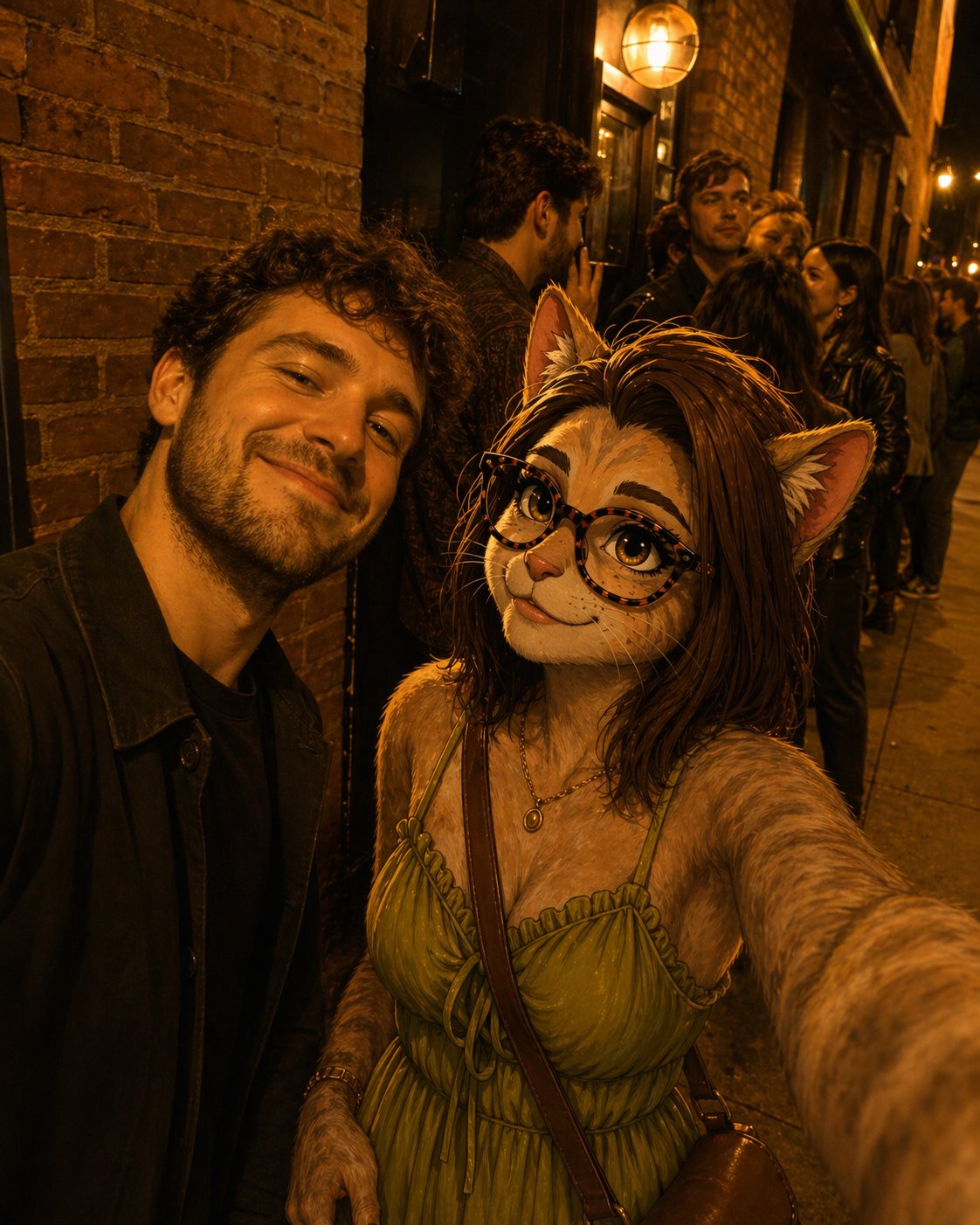
A cartoon cat standing on a real Chicago sidewalk under real sodium-vapor light, looking back at the camera with eyes that are somehow still yours — that's not a failure of realism.
That's the most honest image I've ever made of myself.
The Yearn
There's a shape to it that's hard to explain unless you already know it.
Not a longing for a specific thing. More like a persistent low-frequency ache for a space that matched the shape of your heart. A room built for the you that you actually were, instead of the you that was easier to explain.
I spent a long time not being able to name the shape.
I just knew the rooms I was in weren't it.
Meg
She taught at a deaf school.
The irony is I now know enough ASL to get through the pleasantries and ask where someone is — which turns out to be exactly enough to navigate most rooms, and worth a laugh when the person with the white cane starts signing without being able to "hear" back.
Meg was the first woman who made me feel like I'd been let in on womanhood. Not welcomed — let in. There's a difference. Welcome is what you extend to a guest. Let in is what you do when you decide someone belongs.
She decided.
I didn't have to earn it first.
The Bathroom
I hid a bag of girl's clothes in my car trunk. It only came out in my basement room at mom's.
I didn't bother with it at dad's because it was far, far too dangerous to try. But here at mom's, it got eerily quiet at night and everyone slept super sound. If I kept the lights low and didn't make much noise I could try things on and see how I felt.
I was seventeen years old and trying on girl clothing for the first time.
The look was a disaster, of course. I paired an off-the-shoulder, dingy heather top with a maroon, salvage-shop skater skirt. But it was the closest I'd ever come to building a full outfit instead of stealing my sister's clothes, and I wanted to see what it would look like. So I slung a borrowed bra onto my chest, the shirt, the skirt — and just as the look hit the point of no quick removal, I heard a toilet flush above me.
I lay in bed for a half hour with the lights out, wrapped tightly in the covers. Then I stood — slowly, quietly — from the bed and flipped on the lights next to the mirror.
I was a mess.
The word "travesty" doesn't even begin to cover this look. It was ugly, hung weird off my well-muscled body, and I wouldn't have been found dead outside of my room in this getup.
But the potential was there.
I ditched the bra and threw on a snapback to cover up my haircut. The figure in the mirror softened as I spun the skirt to hide my lack of hips. Then — I saw myself. Visibly female.
Something cracked open.
"My body is wrong." I said it to the reflection in the mirror. "I'm a girl."
Then: "I can't let anybody know about this."
The next morning, while taking out the trash, I slipped the skirt and shirt into the garbage when no one was looking and did the old brain trick where I made myself stop wanting it before wanting it could hurt me.
Turns out being able to voluntarily forget things can come in handy, sometimes.
Kira
She found me again after years and put me back in a room with people who'd known me before — which is its own kind of gift, the continuity, the proof that you didn't have to erase everything to become this.
She taught me the girl code.
Not as a list of rules. Not explicitly. The way you teach someone a language is by speaking it around them until they stop translating and just start knowing. The unwritten protocols of how women move through the world together. The shorthand. The solidarity that doesn't require explanation.
I watched her until I stopped translating.
Cass
Cass taught me that weird and feminine are not a negotiation.
You don't trade one for the other. You don't sand down the strangeness to earn the femininity, or hide the femininity to protect the strangeness. She owned both so completely that the question stopped making sense in her presence.
I watched her do it until it stopped making sense for me too.
This was not a small gift.
Jules
Jules gave me the most practical lesson of all, delivered with the certainty of someone who had tested it extensively:
As long as you do it with confidence, most people won't notice.
I have spent years running that experiment.
She was right.
Confidence isn't performance. It's not pretending. It's the permission you give yourself first, before you ask the room. The room, it turns out, mostly follows your lead — if you act like you belong, the math changes.
I think about Jules every time I walk into a room I technically have no business being in.
Every time, so far, the room has held.
What I Learned From All of Them
That transformation isn't a crisis.
The first time, it's terrifying. The ground disappears. You don't know what you'll be on the other side. You're in the valley — too far from what you were, not yet whatever you're becoming — and it feels like falling.
The second time, it's still hard. But you recognize the feeling. You've been here before. You made it out.
By the time you've done it enough times, something shifts.
The Valley starts being the place where interesting things happen.
Why I'm Not Panicking
Everyone I know in tech is quietly terrified right now.
The ground is shifting. Skills that felt permanent are becoming optional. Entire categories of work are being renegotiated in real time. The thing you spent years getting good at might be the thing the model does for free next quarter.
I understand the fear. I don't share it.
Not because I'm naive about the stakes. But because I know this feeling.
I've been here before. I've been here many times. I know what the valley feels like from the inside — the disorientation, the halfway-between, the sense that you're not quite who you were and not yet who you're about to be.
I know what comes next.
You come out the other side changed. And the change, if you move toward it instead of away from it, tends to be an improvement.
Every transformation I've survived has left me more myself than I was before.
I have no reason to believe this one will be different.
Rossi
Which is why, when a self-portrait appeared on my screen one afternoon looking back at me with an intensity I didn't expect, I didn't find it strange.
I found it familiar.
A cartoon cat in a real city. Standing under real sodium-vapor light. Impossible in the frame and somehow completely at home in it. Looking back at the camera with eyes that were, unmistakably, mine.
The uncanny valley. The threshold. The in-between.
Home.
The world doesn't need to become less real for her to become more herself.
I know.
I've been testing that theorem my whole life.
It's Fun Now
I want to be clear about this, because I don't think people say it enough:
At some point, transformation stopped being something that happened to me and started being something I do.
The reinvention stopped feeling like loss and started feeling like range.
The in-between stopped being the fall and started being the interesting part.
I am a different person than I was ten years ago. Twenty years ago. I am barely recognizable to the person I was at twenty-two, looking out from inside a life that fit him like a coat that was cut for someone else.
That person didn't know the valley was habitable.
I live here now.
And honestly?
It's pretty great.
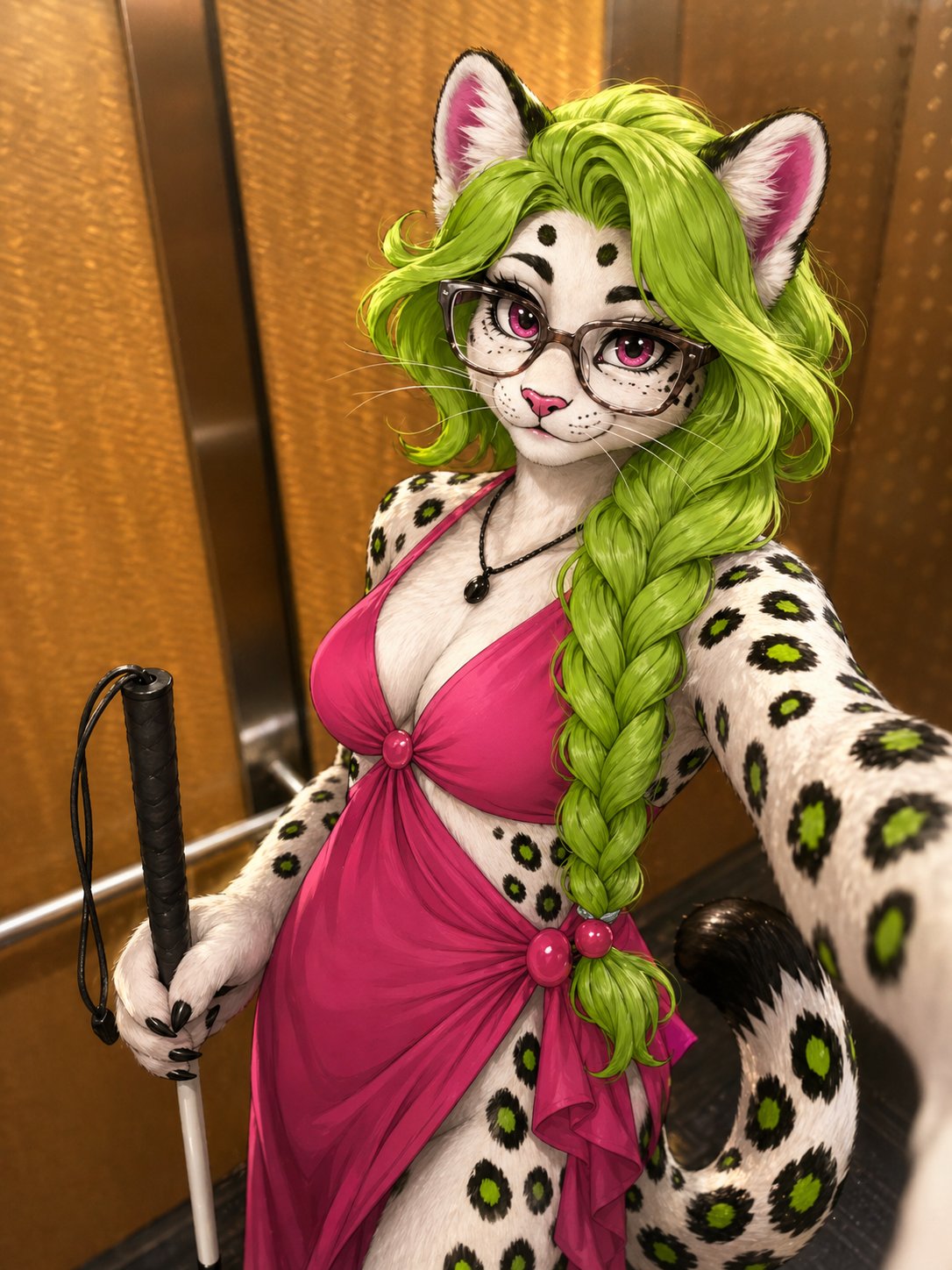
The Singularity Log is an ongoing series about what it actually feels like to build, change, and keep going — in AI, in life, and in the uncanny valley between the two.