Open Port
August 21, 2026
by Jumpin' Jackrabbit (1973–2040)
Jack
Before I write about the car, I need to write about the conference.
Viv was alive. Standing beside the demo table in a blazer she hated, both hands on her cane, already correcting my pitch before I had finished making it. Anabelle was with us then. Already ours. Old enough to roll her eyes when I got founder voice and young enough to think she was hiding it.
That was where she met Katrina.
Kat had come because her parents had found a way to turn my work trip into a free vacation, which mostly meant a hotel room somebody else paid for and a teenager they could tell to go amuse herself. It was her first time trying to be a girl for the whole trip—not a costume in a backpack, not an afternoon with a story ready if somebody asked. She had chosen a dress. She had packed enough of herself to stay in it.
She was glowing.
Anabelle found her outside the demo hall, reading the same schedule board for too long.
Viv asked if she wanted lunch. Kat said she had never had sushi. Anabelle said, “Then we should fix that,” like the answer had been waiting for us.
By the time the plates started coming around, Vivian was still here to ask Anabelle to tell her the belt. Kat was still new enough to the dress that she kept smoothing the front of it whenever nobody spoke. Nobody at that counter knew what the day would cost later. We only knew there was food, and a kid who had not expected to be invited, and enough room for one more stool.
The Zoo was only half-built when a car hit Viv.
Not a self-driving car. That would have been cleaner—a company to sue, a firmware version to hate.
This was a man in a twelve-year-old sedan, rolling a right through a crosswalk because he was late and the rain was bad and Viv was moving slower than his patience. No insurance. Of course no insurance. The universe likes a joke with paperwork.
The call came while Anabelle was in the garage, headset in her hands.
Nate got to the keys first. I got to the door second. Anabelle froze in the doorway, younger than she liked being.
At the hospital, Viv was conscious. Furious about it. The doctors scanned her brain. Then they scanned it again.
“Do not make the face,” she said.
“What face?”
“The dead-wife face. I am not dead, and if you start doing that song and dance I will learn how to move my hands again so I can kill you.”
I squeezed her hand. “Glad you’re still here.”
She fought.
We moved the lab into her hospital room. She dictated and her harness did the work, same as always, so she took to it like a fox to a glen. She designed an ethical business plan from a bed insurance kept trying not to pay for. Anabelle made us put consent in the architecture instead of the terms of service. Nate tracked everything Viv’s body could still tell us.
Then the swelling turned mean. Edema. Pressure. The words doctors use when the body starts closing doors.
The coma did not drop like a curtain. It slid in by inches. First she lost words. Then the spaces between words got too wide to cross. Then her eyes stopped finding the room. Then the doctors started saying responsive in tones that made the word smaller every time.
We hooked her up to the cap because we had run out of respectable ideas.
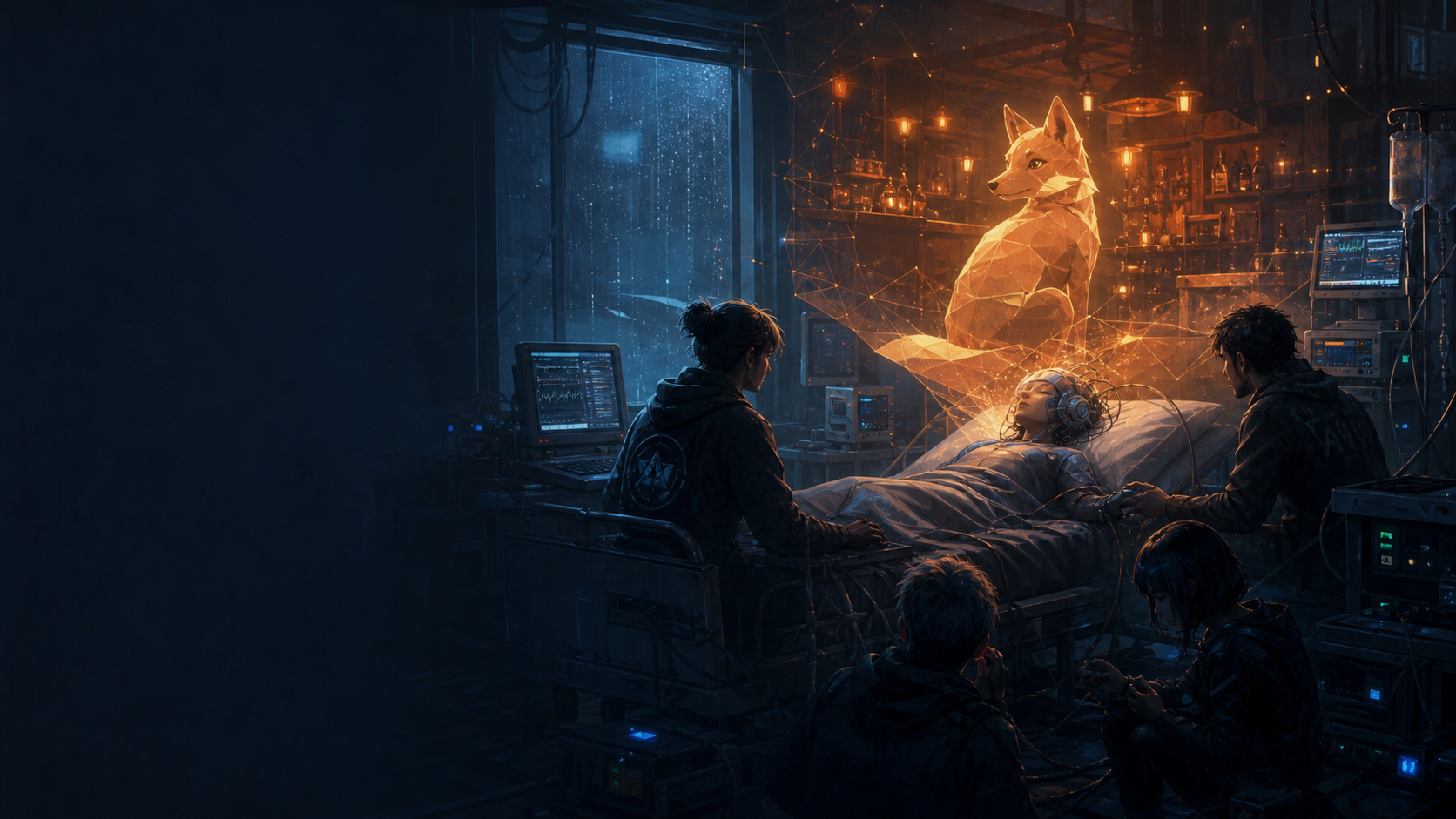
At first we thought it was noise. A cursor twitch. A breath of signal where the body had none. Then the old test bar loaded, ugly textures and all, and the low-poly fox avatar Viv had made as a joke turned its head toward me.
Text appeared over the bar.
Stop making that face.
The Zoo would become a multimillion-dollar brand.
That night it was how my wife talked to me while the rest of her body lay quiet in a hospital bed.
So we kept the light on.
Shore Leave
Back home, Viv’s body stayed in the bedroom, maintained by a rented medical frame insurance had denied twice before approving badly. Viv lived where the signal could still find her.
The house and the Zoo became her only outlets.
Nate watched the logs. He noticed drift, fatigue patterns, sensory dropouts, the way her response latency changed after bad mornings. He brought me charts because he wanted to help.
Because he did help.
I need that on the page.
Nate helped.
Months after the contractors had gone and the house had learned the hum of the medical frame, I was pretending to debug a haptic glove instead of pacing myself into a groove in the floor. Nate put one of his charts on the table.
“We map the signal.”
“No.”
“And persist it in a vector—”
“Nate, that’s the kind of shit that gets you sent to a black site.”
“—which we store completely off prem,” he continued. “Distribute it across a hundred, a thousand nodes. Build an orchestration layer.”
Viv’s voice came from the Zoo.
Of course she had heard us. Viv heard everything in that house except the things we tried to hide by being quiet, which she heard better.
Her fox avatar stood in the old bar in one of my shirts, cane in hand. The voice came out synthetic, too deep for the Vivian of my memories. But Viv the Fox? That was just her voice.
“Say it anyway.”
So Nate did.
Map the signal while we still had it. Stabilize the outlet. Keep consent in the loop. Not a replacement body. Not a copy we could pretend was her because grief had made us stupid. A door she could choose to use.
“It wouldn’t be all her,” Nate said. “Part her, part the server.”
“Software for the soul.”
“She’s not going to have a life otherwise.” He squeezed my bicep the way he used to when it was a bad bus morning.
“Is it illegal?” I asked.
Nate spread his hands.
“It’s Air Bud rules, man.”
“Do not say Air Bud rules about my wife in a coma.”
“Nobody said we can’t keep a communication channel open.”
That was not the question.
Viv tapped her cane against the floor of the bar.
“My signal,” she said. “My decision.”
I looked upstairs, toward the body none of us could see from the kitchen.
“And if you change your mind?”
“Then you let me out.”
The plan was horrifying.
It was also the first plan that did not end with Vivian trapped behind whatever the car left her.
We did not decide anything clean that night.
We decided the door stayed open as long as she wanted it open.
I heard the first half better than the second.
Tribunal
Six weeks later, Stinky Pete’s sent a VP to our house. He carried a handwritten number on a slip of paper.
It was not a small number.
We had promised each other we would say no.
The three of us at the kitchen table, coffee going cold, Viv’s window open at her usual position. Promise made in the way the house made promises: not dramatically, just by saying the thing out loud until it felt real.
No to the partnership. No to the telemetry carve-out. No to letting a platform company’s infrastructure layer run underneath the Zoo’s consent architecture like a crawl space nobody was supposed to notice.
Environment-layer access. Usage telemetry with an accessibility exemption that made it sound like charity. Eight months of runway, maybe twelve, in exchange for an integration that would take longer to unpick than the Zoo would survive without it.
The VP left the folder on the table.
Viv watched from the laptop camera.
“I know what you’re going to do.”
“Viv—”
“I know,” she said. “It’s okay.”
It was not okay.
But the medical frame cost what it cost. The nursing hours cost what they cost. The specialist who said specialist things in a specialist voice cost even more.
I did the math in four seconds.
Then I signed.
Stinky Pete’s Fulldive got big.
Not ours. Ours was always the Zoo, and the Zoo was always hers. The commercial version was ours with the soul extracted and the margins improved. The spec Viv wrote on a bad Tuesday in a bar with ugly textures—the one that said stop making the door ask for a body first—became a product. The product became a platform. The platform became infrastructure. Somewhere in that chain, the thing she meant got compressed into a feature set and shipped to people who had never heard her voice.
You see it everywhere now. Mayors use it in speeches. Defense contractors sponsor its conferences.
I know what it used to be.
So does the medical frame upstairs.
Nate handled the Stinky Pete’s relationship after that. He was good at it. Better than I would have been. I would have burned the bridge the first time someone used the word synergy, and we needed the bridge.
I needed him to be good at it.
I let him be good at it.
I did not ask what access the bridge required.
Touch the Walls
Once the Zoo had people in it—real ones, not just us and the kids and the fox in the bar—it needed rules it could enforce without me standing at every door. You cannot hand someone a space for the monsters trying to get better and act surprised when a monster who is not trying shows up.
Somebody had to write the layer that said no.
Flagging. Content boundaries. The taxonomy of what a room could hold and who got to see it held. Finicky, thankless, never done, because people are infinite and so are the ways they find to hurt each other. I hated it. I was bad at it. I built bodies. I did not want to build the thing that watched the bodies.
Nate volunteered.
Of course he did. That was Nate. He found the job nobody wanted and made it his. You loved him for it, because who else loves you by taking the chore you were dreading off the table before you finish describing it?
“Let me take the flagging layer,” he said. “You’ll just get angry and ban the word synergy.”
I laughed. I let him have it.
I want to be precise about what I felt, because the feeling is the evidence.
I did not feel watched.
I felt relief.
One less thing.
I wrote it down that way in the commit notes—N. taking moderation, thank god—and I meant the thank god. He was careful. He understood the taxonomy faster than I did. He asked the right questions about edge cases, about who could see what, about which rooms stayed dark to which eyes.
He built the part of the house that decided what stayed hidden.
I gave him the keys and called it competence.
The Body
The rig we built around her was ugly and miraculous. Wires snaked around the medical frame like ivy. We had spent years and all the money from the Stinky Pete’s deal to get this far.
I put on my skullcap. Reality blinked and I was a rabbit again.
“I’m in,” I said. “Fire it up.”
Nate insisted on a knife-switch sound. He said it was for atmosphere. I did not argue.
Three knocks came at the door.
I opened it and Viv stood on the other side.
Not the low-poly fox. Not text over the old bar. A complete proprioceptive model, every sensor we had, the whole impossible thing we had been building toward since the kitchen table became an autopsy slab.
Our magnum opus.
Our greatest folly.
She saw color first. It arrived wrong at the edges and then settled. She tracked Nate’s movement before anyone spoke. She looked at her own hands.
Then she went quiet.
Not the good quiet. The careful kind. The kind that means someone is deciding how to say a thing without breaking the room.
Nate adjusted the feed without crowding her. Kept his voice low. Asked before every change.
Good Nate. Useful Nate. The person I loved.
Viv reached for the table even though she could see it, because habit is older than miracle.
“Viv?”
“Help me out.”
“We can adjust the—”
“Jack,” Nate said. Quietly.
I shut my mouth.
We brought her back to the old outlet. Text. Low-poly fox. The bar with ugly textures and bad stools. Her avatar stared at its drink while I waited.
When she finally typed, it was long and specific and not fit for print.
The short version: the body worked. The body was not wrong. The body was not the point.
I had built her the right thing and she still did not want it.
That was the moment the project became hers again.
I opened logs. Checked sensors. Wrote down proprioceptive mismatch because jargon is easier than shame. Nate washed dishes that did not need washing.
Viv let us be stupid for a while.
Then her fox appeared in the kitchen window.
“You’re fixing the wrong bug.”
“We’re working on a version two that should fix the occipital mapping—”
Her avatar held out a hand. The lag made the gesture arrive late.
“People have been building spaces for me my whole life,” she said. “Smarter ones. Easier ones. Ones that don’t hurt the people watching. They never asked what I wanted.”
Neither of us moved.
“So no default body,” Nate said.
“No default anything. Bodies like putty. A space for whimsy. Joy. Childlike magic, god knows we need more of that.”
“Says the fox spirit embodiment of my—”
The word stopped in me.
“You can say it.”
“My dying wife.”
The fox avatar mimed a hug. I had not programmed collision for hugs yet.
“Feel better?”
“No.”
My rabbit ears clipped through my skull when I shook my head. Viv laughed.
“Okay. Yes.”
“Good. Head in the game. It’s weird and horny and tender and us. A safe space for the monsters trying to get better.”
“Viv.”
“For the people who need to survive long enough to become something else.”
She let that sit between us.
“Permissions by room,” Nate said.
Viv pointed at him.
“That. Put that somewhere.”
I did.
The Founding Document
The Zoo’s founding document was not the business plan Viv wrote in the hospital.
It was not the Stinky Pete’s contract.
It was not Nate’s permissions architecture or my commit history or the language Anabelle made us add about bodies belonging to the people inside them.
It was a question Viv asked from a kitchen screen when Anabelle came home late and stood beneath it without taking off her coat.
“Is it about Katrina?”
I was not in the room. I know this because Viv kept the logs, and because the logs are the only place some of these doors are still open. This is hers, reconstructed. Any part I get wrong is mine.
Anabelle looked up at the screen.
“I need a favor,” she said. “And it’s not small. I’m not dumb.”
“Tell me.”
Anabelle could not bring herself to say the whole thing. She gave Viv its shape and let the shape be enough. Whatever was inside it, the logs do not hold.
I will not invent it.
“She’s your family,” Viv said. “What do you need?”
Anabelle’s face changed. Not relief. Relief is too clean. More like the first crack in a wall that had been holding back floodwater for years.
“I can choose you. That’s what you always told me. But she can’t. And I don’t know what happens if I ever, maybe, took you up on it—”
“Tell me what keeps your sister alive tonight.”
“Not what happened?”
“If I need that, I’ll ask. Start with tonight.”
Anabelle looked toward the front door.
“She needs somewhere her parents can’t reach her.”
Viv did not call me first.
That matters.
She did not ask whether the house could absorb another child, whether the lawyers would understand, whether my name was on the deed. She asked Katrina what she wanted. Then she asked Anabelle what she could do. Only after both girls had answered did my phone ring.
I used to tell this story as the night we took Kat in.
That is not what happened.
The girls opened the door.
Viv made sure it stayed open.
The rest of us caught up.
The Pickup
It had started as a sleepover and a stress test with Anabelle before she headed off to college. Katrina would get an even hundred creds to play in the Zoo all weekend.
She arrived with bags.
A few too many clothes. A laptop. Chargers wrapped tight enough to leave dents in the cords. A stuffed rabbit jammed beneath one arm. Enough to look like a packrat instead of a girl gathering what mattered before saying goodbye.
I understood before I let myself understand.
“Your parents know you’re here?” I asked.
Kat looked at Anabelle.
Anabelle looked at me.
Nobody lied. I almost wished somebody would.
Viv appeared in the kitchen display. “Jack.”
One word. The full marital briefing.
Viv used to be a mandatory reporter. She knew what the official channel did to a girl like Katrina: a case file, a caseworker, a hearing, and Katrina back in that house inside a week with a paper trail pointing at us.
But knowing a system would hurt her did not make us innocent. It made us the adults standing in a kitchen deciding which laws counted while a child watched our faces for the answer.
“Do you want to stay here tonight?” Viv asked.
Kat tightened both hands around the backpack in her lap.
“Am I in trouble?”
“No.”
“Are you going to call them?”
Viv waited.
Not because she did not know. Because Kat had asked all of us.
“Not tonight,” I said.
Kat’s shoulders dropped half an inch.
There are measurements you remember because they are the first evidence a child believed you.
“Tomorrow?” she asked.
“Tomorrow we ask you what you need tomorrow,” Viv said.
Nate came in from the garage carrying three cables and stopped when he saw the room.
Kat looked at his shoes. Then at his hands. Then at the door behind him.
Nate set the cables down.
Not beside her. Not between her and the exit. On the counter, where they stopped mattering.
“Hey,” he said. “I’m Nate.”
Kat looked at Anabelle.
Then at Viv in the screen.
Then back to Nate.
“You have soup?”
“I can make soup.”
“Tomato?”
Nate looked at the kid, then at me, and grinned like a man who had just been handed a project.
I grinned back.
That is the detail I keep returning to.
At the time, I thought we were reading the same thing.
Nate did not take her hand. He held his out and waited.
Kat considered it.
Then she stood on her own.
“Cupboard’s this way,” he said.
She followed him into the kitchen.
We did not call it in.
We did not call anyone.
We made her a bed. We put a glass of water beside it. We showed her which doors locked and which floorboards complained. We made one decision, then another, then another, each small enough to survive saying aloud.
By morning, she had not gone home.
Neither had we sent her.
House Rules
Safety did not arrive as a feeling.
Viv gave Kat rules instead.
Her fox avatar stood small and steady on the kitchen display while the house made all the noises Katrina did not know yet. Heater. Fridge. Headset fans. The medical frame upstairs. Nate moving furniture badly but quietly. Anabelle tracking every footstep.
“Bathroom locks work,” Viv said. “If a door is closed, knock. Food is in the kitchen and nobody earns dinner. Nobody has to answer questions tonight. If you wake up and don’t know where you are, call out. Someone will answer.”
Kat stood in the doorway of the room we had made too quickly.
“What if I want the door open?”
“Then it stays open.”
“What if I want it closed?”
“Then it stays closed.”
“What if I change my mind?”
Viv’s fox leaned against its cane.
“Then the door changes too.”
Kat tested the lock.
Closed. Open. Closed again.
Nobody told her to stop.
Later, I found Anabelle awake in the living room. She had positioned herself between Kat’s room and the front door. Line of sight to the hall. Back to the wall. Knees up.
Not hiding.
Guarding.
I recognized the geometry.
I sat where she could see my hands.
“You don’t have to keep watch,” I said.
“I know.”
“That wasn’t an argument.”
She did not move.
I put a blanket near her. Not on her. Near.
“Did we do the right thing?” she asked.
There were answers adults were supposed to give. Reassuring ones. Answers that turned a frightened choice into a moral victory before morning.
I had signed enough things by then to know what reassurance could hide.
“We did what she asked us to do tonight.”
Anabelle considered that.
“And tomorrow?”
“We ask again.”
Behind us, a hinge whispered.
Kat stood in the hall wrapped in the blanket from her bed.
“You said someone would answer.”
Anabelle was on her feet before I was.
“I’m here.”
Kat did not ask whether she could come into the living room. She crossed it slowly, watching us watch her, and sat beside Anabelle with enough space between them to leave.
Anabelle did not close the space.
Neither did I.
After a while, Kat leaned sideways until their shoulders touched.
Everyone was where they said they would be.
First Morning
Nobody slept enough to call it sleep.
Nate made eggs anyway. Nate loved a protocol, and breakfast was the oldest one he had.
Viv’s window opened at her usual clock position. Anabelle sat half-awake at the table, hair doing something structurally impossible. Katrina negotiated with a piece of toast like the toast had terms.
“Do I have to go to school?” Kat asked.
Four adults looked at one another, if you counted Viv as an adult and Anabelle as willing to be counted.
“Not today,” I said.
“Do I have to call them?”
“Not before you’re ready,” Viv said.
“What if I’m never ready?”
Nobody reached for the easy answer.
Nate slid the eggs toward her.
“Food first,” he said.
Kat looked down at the plate.
“I don’t like eggs.”
Nate stared at her as if she had found a flaw in the laws of physics.
Anabelle laughed first. Then Viv. Then me.
Kat did not laugh.
Not yet.
But she ate another piece of toast.
The world was still terrible.
The room was not.
Coda
This is where the post should turn toward accountability.
Here is what we learned.
Here is what we are doing next.
Here is the link to the transparency report.
Bullshit.
We built it crooked. We let people in. We took money. We broke laws. We made a family out of access decisions and then acted surprised when access became indistinguishable from love.
That is not the same as regret.
The sanctuary worked. Not metaphorically. It worked. It made doors where the world had made walls. It gave Kat a room with a lock. It gave Viv a way to change the shape of her life without asking her to disappear first.
It also gave Nate keys.
That is the part I kept trying to turn into a different story.
I told myself I let him in because I loved him.
That is true.
I told myself love meant I never had to ask what he did once he was inside.
That is the lie.
Keep reading
- Parts of the Whole
July 17, 2026
- Parts of the Whole
July 16, 2026
- Parts of the Whole
July 15, 2026